


















by: Remshay Ahmed
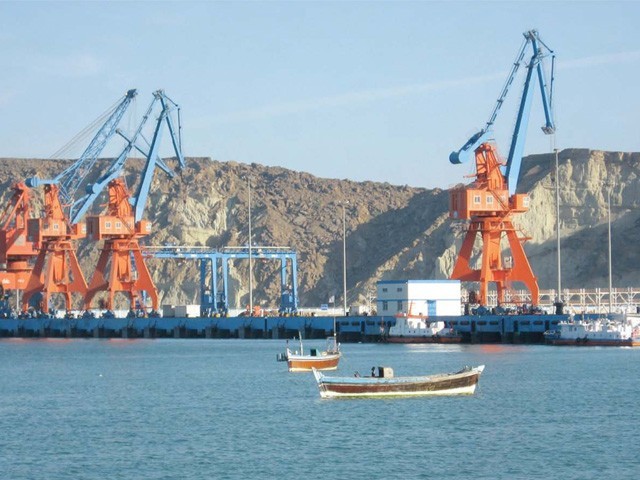
There has been a lot of talk of whether Gwadar will overtake Dubai in the future, given the amount of investment it is seeing under the China Pakistan Economic Corridor (CPEC). However, the fact remains that it is going to take quite a bit of time for Gwadar to develop, and even then, the question shouldn’t be whether it will overtake Dubai.
Pakistan falls in the MENAP region and the regional growth for this is expected to increase to 4 per cent in 2017 and 4.4 per cent in 2018. CPEC will help Pakistan facilitate this growth process and take its share. Prominent businessmen like Mohammad Mansha have stated that CPEC will help Pakistan achieve the central position in global economics.
Given this, the likelihood that our position will become stronger in terms of our collaborative relationships is higher than the likelihood of Gwadar obliterating Dubai from the sea-traffic map.
The CPEC connection:
CPEC is expected to serve 3 billion people, which is perhaps half of the entire global population. Therefore, its economic potentials and outreach are much greater than any other economic project. It is expected to connect entire China, Europe and Africa and indirectly connect the Americas as well.
Gwadar is growing at an exponential rate. There seems to be a rapid increase in the construction work because of the increased Chinese involvement in the area and resultantly, the investor interest in the region has increased. Real estate and property in Gwadar are developing rapidly. Data at Zameen.com shows that prices have jumped 248 per cent in the last three years, and will jump another 300 per cent in the next three.
Development is ongoing, but this city isn’t going to take a few months to develop, it will need some time before it’s in a shape to become a big player in the global economy. Meanwhile, numerous projects (energy, infrastructure etc.) are underway, which will contribute to the overall economy of the region.
CPEC is China’s vision for a more connected future, and Gwadar is a big part of this vision. Because of the development in Gwadar, investor confidence in the economy has increased. Foreign investment in the country has surpassed $ 2 billion mark. While China remains as the leading investor in the region, Netherlands is the second biggest investor in the country, with an investment of $ 879 million in July-May. Countries like France, Norway, Turkey, Tajikistan and Azerbaijan are also interested to invest in the economy.
Recently, the Ambassador of the Islamic Republic of Azerbaijan to Pakistan Ali Alizada, met KP Chief Minister Pervez Khattak to strengthen economic ties between both the countries. According to Alizada, KP seems as a more feasible place for investment and carrying out bilateral trade relations between both the countries.
Russia also seems interested in the economic corridor as it is considered the only one of its kind to connect Central Asia with the rest of the world. In one way or another, the entire world is expected to be connected through this route. This further increases prospects for Gwadar and validates its geostrategic position that it has.
Developments in the Strait of Hormuz:
The Iran-India pact under which Chabahar Port has emerged is seen as an effort to counterbalance the Chinese trade monopoly (emerging as a result of CPEC). It is also suspected of gaining backdoor entry in Afghanistan. Iran has also taken an interest in Gwadar; Chabahar is no match for the magnitude of investment that the CPEC has. It can’t compete with CPEC because an extensive road-rail link that it lacks and India might not come forward to match CPEC’s multi-billion dollar investment. It is also a natural harbour and the deepest in Asia suited to dock ‘very large crude carriers’ and will not require massive maintenance effort. From this, one begins to understand that India might be interested to be a part of CPEC, at least if it can’t compete with it.
These developments at the Strait of Hormuz appear to be a competition for UAE which it will not be able to dominate and both of these competing ports are bound to shine away interest from UAE. This along with other straits are predicted to be very important geostrategically in the future and whosoever dominates this area will have an upper hand in global economics.
UAE vs Gwadar:
UAE’s Economy Minister Al Mansouri has planned to expand the contribution of its industrial sector (which stands at 16 per cent) to 20 per cent of GDP by 2021. Furthermore, travel and tourism alone have remained the best performing category (index at 54.8 in October 2016). This highlights how even when the emirate was experiencing an economic crunch, they were able to replenish themselves from non-oil sector.
For people that claim Dubai will be easy to overtake, they need to keep in mind that the place isn’t to be taken lightly, however. It has withstood the pressures of the 2007-8 oil crises and continues to grow despite an overall sluggish scenario for other GCC countries in 2017. Here the non-oil GDP is expected to grow by 2.7 per cent in 2016 while oil GDP growth is forecasted to increase by 1.2 per cent.
Gwadar can use the UAE as a blueprint, but in order to go above and beyond it needs to be bigger and better. UAE remains the top country in the Middle East for doing business. This is primarily because of the stable political and security climate of the UAE that helps it stand out in the region. This is also the sore point which may come to haunt Gwadar, i.e. unless security is brought under control, there is no way the city can overtake any port city in the world much less Dubai.
Gwadar has all the ingredients it needs to succeed. CPEC is only one part of the puzzle – its position helps it to attain the geostrategic importance that is instrumental for its OBOR initiative. Realising this and learning from the catastrophe that the Kalabagh dam became, the Pakistani authorities now know that it is integral to not politicise the corridor under woes of provincialism and to make it secure. Stability in Balochistan is of utmost importance.
The only way success of CPEC can be lost and Gwadar’s geostrategic position jeopardised is if the security situation in the country isn’t maintained. The biggest challenge facing the present and future governments is to commit ground forces to ensuring the sustainability of CPEC. Only then will it be able to survive any challenges that come its way. Prospects for Gwadar are bright and it is possible that in the coming decades it will surpass UAE.